A single mis-specified commercial asynchronous motor can trigger **$18,000 or more** in field rework, delayed commissioning and voided OEM warranties. Procurement teams absorb that cost every quarter because they treat induction motors as commodity items rather than system-critical components. This commercial asynchronous motor procurement guide exposes seven supplier red flags that inflate equipment budgets by an average of **32%**—and gives you the exact checklist to eliminate them.
## Why Commercial Asynchronous Motor Procurement Is a Hidden Cost Center
Industry audits show that **1 in 4 equipment projects** absorbs at least one motor-related rework charge before final commissioning. A commercial asynchronous motor—also called a commercial induction motor—drives the compressors, pumps, fans, conveyors and HVAC loads that keep facilities running. When procurement treats this motor as a generic commodity, hidden costs surface downstream: mismatched mounting frames, undersized service factors, non-traceable certifications and warranty disputes.
**Reliable manufacturers typically** publish full nameplate data, batch test reports and export certificates before quoting. Unreliable suppliers hide behind vague catalog sheets and verbal promises. This commercial asynchronous motor procurement framework helps buyers separate engineering-grade partners from transaction-only resellers.
## The 7 Supplier Red Flags That Inflate Commercial Asynchronous Motor Costs
### Red Flag 1: Vague Efficiency Class Claims
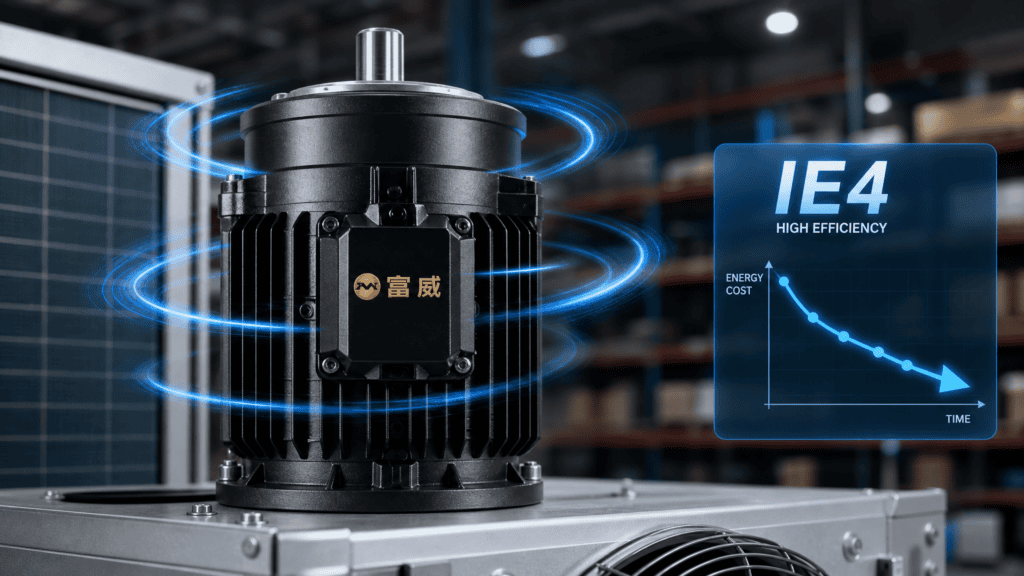
A supplier that says “high efficiency” without specifying **IE3, IE4 or NEMA Premium** compliance is guessing. For commercial asynchronous motor procurement, efficiency class directly determines energy cost and local code compliance.
Industry audits show a 15 kW IE3 motor can save **$1,200–$2,400 per year** versus an old IE1 unit in continuous duty. Demand the exact standard and the test certificate number.
### Red Flag 2: Missing Locked-Rotor and Service Factor Data
Most sourcing failures start with a motor that cannot start the driven load. A commercial asynchronous motor must match the equipment’s **locked-rotor torque, pull-up torque and service factor**.
Suppliers that cannot provide these curves expose you to stall failures. To avoid costly chargebacks, require a complete torque-speed curve and a stated **service factor of 1.15 or higher** for continuous commercial loads.
### Red Flag 3: Certificate Copies Instead of Traceable Certifications
A photocopied CE or UL mark is worthless in an audit. Complete export certification means the certificate number traces to the actual manufacturer and production batch.
Reliable commercial asynchronous motor suppliers typically provide **CE, UL, CSA, IEC 60034** and often **CCC or UKCA** documents with verifiable numbers. Ask for a certificate you can validate online before you commit.
### Red Flag 4: “Custom” Pricing Without an Engineering Review
Custom voltage, flange or shaft modifications without an engineering drawing is a red flag. In commercial asynchronous motor procurement, a legitimate custom order includes a **pre-production drawing, tolerance sign-off and sample or golden-unit approval**. Suppliers that quote custom work in minutes—without a technical review—will likely ship a “close enough” motor that breaks equipment compatibility.
### Red Flag 5: MOQ Traps and Phantom Stock
“Stock available” often means “we can source it in six weeks.” Confirm **actual on-hand inventory and production lead time** in writing. Factory-direct suppliers with dual delivery models—**stock for urgent replacement plus custom for new projects**—eliminate phantom-stock risk.
This flexibility matters when a facility loses a compressor motor and cannot wait eight weeks. The same logic applies to commercial asynchronous motor replacement stock for multi-site operations.
### Red Flag 6: No Batch-Level QC Records or Test Reports
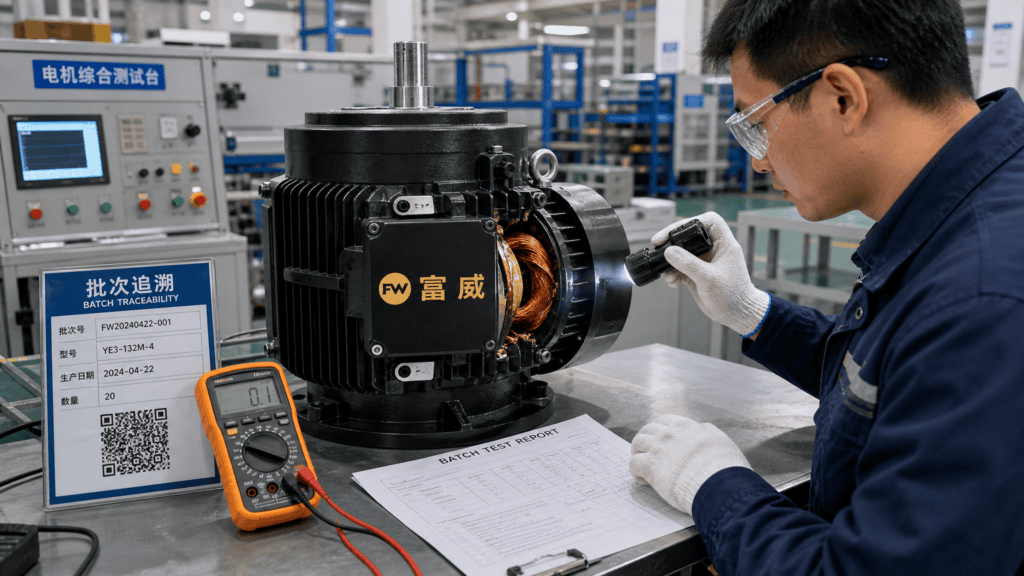
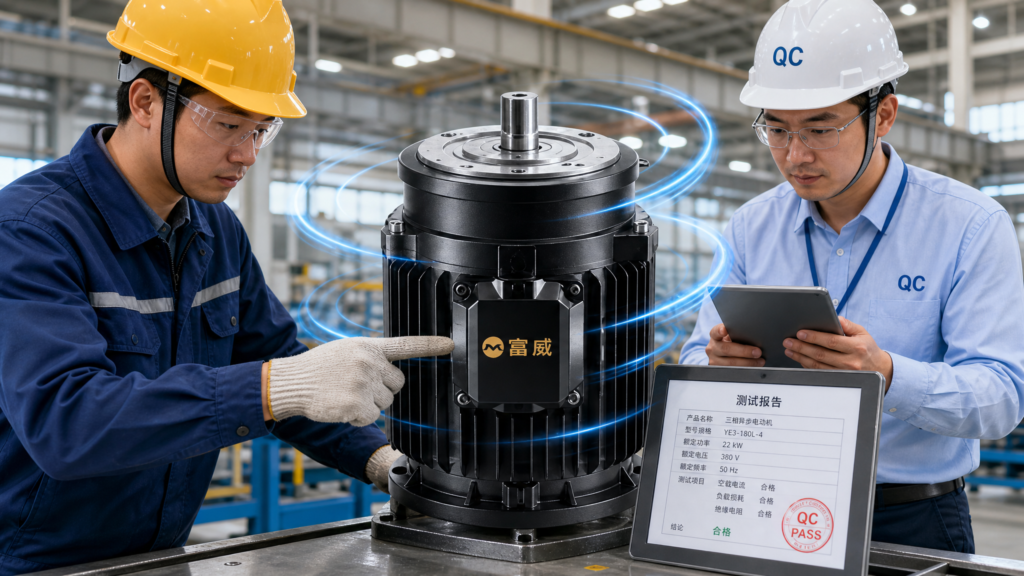
A supplier that cannot produce a **routine test report (no-load current, winding resistance, vibration, insulation resistance)** for the batch is not a manufacturing partner. Full-process industrial QC means the motor is tested at multiple stations—winding, balancing, assembly, final load test—not just visually inspected at the dock. Request the QC file before payment, not after delivery.
### Red Flag 7: Weak After-Sales and Warranty Logic
Warranty claims fail when the supplier blames the installer. Strong commercial asynchronous motor procurement agreements define **installation requirements, ambient temperature limits, duty cycle and claim response time**. Reliable manufacturers typically offer a written warranty with a clear claims process and local service support, because they own the production line and can actually honor it.
## Technical Specification Traps That Break Equipment Compatibility
### Voltage, Frequency and Altitude Derating
A motor rated for **400V/50Hz** will not perform identically on **480V/60Hz** without derating. Altitude above 1,000 meters reduces cooling and requires a derate.
Industry audits show that voltage/frequency mismatch is one of the top three causes of premature winding failure in commercial asynchronous motor applications. Always confirm the motor’s rated voltage range and derating curve against the facility’s actual supply.
### Frame Size, Mounting and Shaft Tolerance
Interchangeability is not automatic. **IEC frame sizes (e.g., 132M, 160L)** and NEMA frames use different shaft heights, flange patterns and foot dimensions. A “same kW” motor can still have a different shaft diameter, keyway or terminal box position.
For equipment compatibility, send the OEM’s dimension sheet and request a **dimensional drawing sign-off** before production.
### Duty Cycle, Starting Method and Protection Rating
Continuous duty (**S1**) is the baseline for most commercial pumps and fans, but compressors and cranes may need S4 or S6 duty. Starting method—**DOL, star-delta, soft starter or VFD**—changes inrush current and required insulation class.
Specify **IP55 or higher** for washdown or dusty environments. Every mismatch creates an equipment matching risk that no warranty will cover.
## Factory-Direct QC, Certification and Dual Delivery: What Reliable Manufacturers Provide
### Full-Process In-House Industrial QC
A true factory-direct asynchronous motor manufacturer controls the process from lamination stamping and winding to dynamic balancing and final load testing. This vertical control reduces defect escape rates and gives buyers a single accountable source. Ask for **in-process inspection points and a final test report** tied to the serial number of each commercial asynchronous motor.
### Complete Export Certification
For cross-border commercial projects, complete export certification is non-negotiable. Reliable manufacturers typically maintain **CE, UL/CSA, IEC 60034, RoHS and regional safety marks** with current test reports. Verify that the certificate holder matches the factory name on the nameplate—mismatched names are a common grey-market warning sign.
### Stock + Custom Dual Delivery and Project Scalability
Commercial buyers need both speed and flexibility. A supplier with **ready-stock standard motors plus a custom line** can ship replacement units in days while still supporting engineered orders for OEM equipment.
This dual delivery model signals genuine production capacity: small commercial projects and large bulk orders are both accepted without artificial minimum-order barriers. For commercial asynchronous motor buyers managing multi-site facilities, that scalability removes the biggest sourcing bottleneck.
## The Commercial Asynchronous Motor Procurement Checklist
### The 10-Point Pre-Order Audit
– Confirm exact **efficiency class (IE3/IE4/NEMA Premium)** with certificate number.
– Request **torque-speed curve, locked-rotor torque and service factor** in writing.
– Match **voltage, frequency, altitude and ambient temperature** to the site.
– Verify **frame size, mounting type, shaft dimensions and terminal box position** against the OEM drawing.
– Validate **CE/UL/CSA/IEC certificates** online against the actual factory name.
– Require a **routine test report** tied to the motor serial number.
– Confirm **real stock availability and production lead time** in writing.
– Clarify **MOQ, freight terms and dual delivery** options for urgent replacements.
– Define **warranty terms, claim response time and installation limits**.
– Ask for **engineering sign-off on custom modifications** before production.
### MOQ, Freight and Payment Terms That Protect Margins
Factory-direct commercial asynchronous motor procurement should not force a 200-unit minimum on a facility that needs 12 motors. Look for suppliers that scale MOQ to project size. Confirm **Incoterms (FOB, CIF, DDP)** and whether freight includes the final delivery point.
Reliable manufacturers typically split payment into a deposit and balance against a **pre-shipment inspection report**, which protects both parties.
## Conclusion: 3 Takeaways and Your Next Step
1. **Specification accuracy beats price.** Most commercial asynchronous motor failures trace back to torque, voltage or frame mismatches, not manufacturing defects.
2. **Certification must be traceable.** A verifiable certificate number tied to the real factory separates genuine export-grade suppliers from grey-market resellers.
3. **Dual delivery and QC records reduce risk.** Stock availability, batch test reports and a written warranty turn a commodity purchase into an engineering-backed decision.
Use this checklist to audit your current supplier before your next order. If any box comes back blank, you have already found the red flag that will show up as a field failure later.
—
## 📚 Related Resources
1. Anchor: “Download the asynchronous motor specification checklist” → URL slug: /asynchronous-motor-specification-checklist
2. Anchor: “Compare IE3 vs IE4 efficiency for commercial motors” → URL slug: /ie3-vs-ie4-efficiency-commercial-motors
3. Anchor: “How to verify CE, UL and CSA motor export certifications” → URL slug: /verify-motor-export-certifications
4. Anchor: “Factory-direct vs distributor motor sourcing: total cost of ownership” → URL slug: /factory-direct-vs-distributor-motor-tco
—
## ❓ Frequently Asked Questions
**Q:** What is a commercial asynchronous motor, and where is it used?
**A:** A commercial asynchronous motor (also called an induction motor) converts electrical energy into mechanical torque for pumps, fans, compressors, conveyors and HVAC systems. It is valued for simple construction, rugged reliability and low maintenance in continuous commercial duty.
**Q:** What certifications should a commercial asynchronous motor supplier provide?
**A:** Reliable suppliers provide traceable CE, UL/CSA, IEC 60034 and regional safety marks such as UKCA or CCC. The certificate number should match the actual factory name on the motor nameplate and be verifiable online.
**Q:** How do I avoid equipment compatibility issues when buying commercial motors?
**A:** Match voltage, frequency, altitude, ambient temperature, frame size, mounting type, shaft dimensions, duty cycle and starting method against the OEM drawing. Request a dimensional sign-off and a torque-speed curve before production.
**Q:** What is a reasonable MOQ for commercial asynchronous motor orders?
**A:** Factory-direct suppliers usually scale MOQ to project size. Small commercial projects may order a handful of units, while bulk OEM orders receive tiered pricing—without artificial minimums that force overbuying.
**Q:** How do I verify a supplier’s QC process before ordering?
**A:** Request batch-level routine test reports (no-load current, winding resistance, vibration, insulation resistance) tied to the motor serial number. Ask for in-process inspection points and a pre-shipment inspection report before the balance payment.