**Roughly 1 in 4 commercial equipment retrofits fails its first commissioning run** because the asynchronous motor was never matched to the real load profile. A single **commercial asynchronous motor procurement** error—like accepting an aluminum-wound motor for a high-start-torque conveyor—can add **$18,000–$25,000 in rework and downtime**. Most of these failures are not manufacturing defects. They are spec, certification, and supplier-selection mistakes made on paper, weeks before the motor ships.
This guide breaks down the red flags, quality-control checkpoints, and dual-delivery models that protect your equipment budget from matching risk.
## Why Commercial Asynchronous Motor Procurement Fails Before the Motor Ships
Industry audits show that **60–70% of motor-related downtime** in commercial HVAC, pumping, and material-handling systems starts with a procurement mismatch, not a worn-out motor. Asynchronous (induction) motors are forgiving machines, but they are not universal. A motor selected only by horsepower and frame size ignores torque curves, duty cycles, and ambient conditions—the exact variables that create **equipment matching risk**.
### The Horsepower-Only Trap
Horsepower is a thermal rating, not a torque promise. A fan needs low starting torque, while a crusher or conveyor needs high starting torque.
– **Locked-rotor torque** determines breakaway performance.
– **Pull-up torque** decides whether the motor accelerates through mid-speed load peaks.
– **Breakdown torque** sets the maximum overload the motor can handle before stalling.
Ordering the wrong NEMA design class for either application is the fastest way to trip overloads or stall under load.
### Duty Cycle and Service Factor Mismatches
Commercial equipment rarely runs one clean profile. Pumps cycle, compressors load and unload, and conveyors start under load.
– **S1 continuous duty** suits fans and pumps that run uninterrupted.
– **S3 intermittent duty** suits hoists, cranes, and cyclic equipment.
– A **1.0 service factor** motor run at 1.15 continuous overload shortens winding insulation life by roughly **half for every 10°C rise**.
Confirming duty cycle and service factor on the datasheet prevents a motor that runs hot from day one.
## 7 Commercial Asynchronous Motor Supplier Red Flags That Add 25% to Your Cost
These seven red flags appear in quotes, datasheets, and sales calls. Each one adds measurable cost to **commercial asynchronous motor procurement** if it slips through unchecked.
### Red Flag #1: No Factory-Direct Traceability or In-House Quality Control
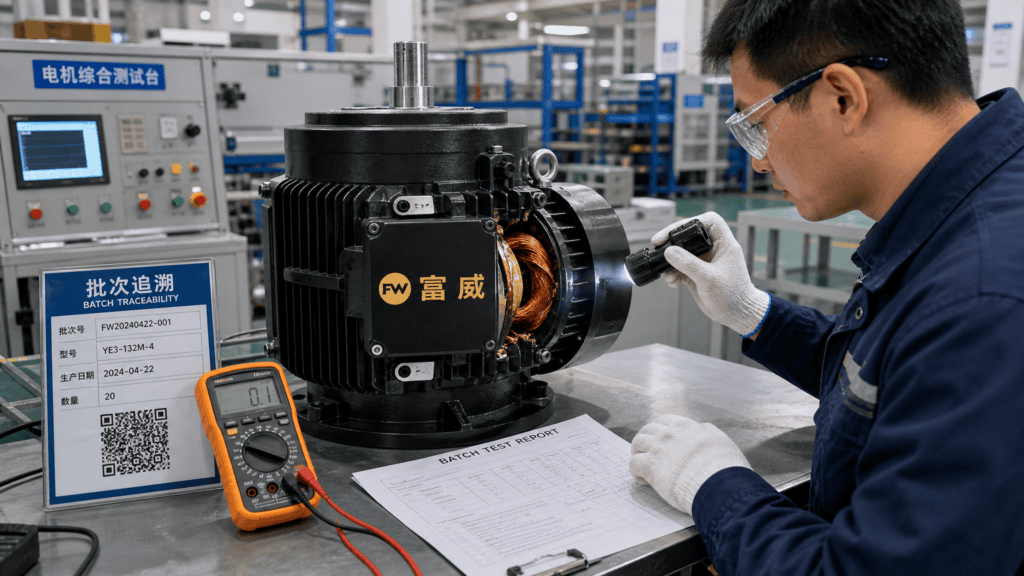
Resellers who cannot show winding, rotor casting, and final test records add a layer of risk you cannot audit. Reliable **commercial asynchronous motor** manufacturers typically keep **batch-level traceability**: lamination lot, copper source, insulation class, and final test data. If a supplier cannot name its production line, treat the quote as a gamble.
### Red Flag #2: Missing or “Equivalent” Export Certifications
“Self-certified” or “equivalent to CE” is not certification. In export projects, a missing **CE, UL, CSA, or IE3/IE4** mark on a **commercial asynchronous motor** can stop customs clearance and trigger chargebacks. Always verify that certificates match the exact model and frame number, not just the brand.
### Red Flag #3: Stock Promises With No Custom Engineering Backup
A **commercial asynchronous motor** supplier that only sells from a catalog cannot adjust mounting, shaft, voltage/frequency, or protection rating. When your OEM frame changes or a site requires a non-standard shaft, you are stuck. A dual **in-stock + custom delivery** model covers both urgent replacements and engineered integrations.
### Red Flag #4: Vague MOQ Traps and Hidden Tooling Charges
Low unit price plus a high “setup fee” is a classic trap. Ask for the **all-in price at 10, 50, and 200 units**.
– Tooling fees that disappear at one quantity and reappear at another signal a reseller, not a factory.
– Packaging, palletizing, and freight surcharges should be line items before you sign.
– A real factory-direct supplier quotes transparent bracket pricing and accepts **small and large commercial project orders** on the same terms.
### Red Flag #5: Opaque Winding Materials—Aluminum vs. Copper
Aluminum windings raise operating temperature and reduce efficiency at the same frame size. If the datasheet does not say **copper winding**, assume it is not. For continuous-duty **commercial asynchronous motor** loads, copper windings typically deliver lower losses and longer insulation life.
### Red Flag #6: No Batch Test Reports or Load Testing
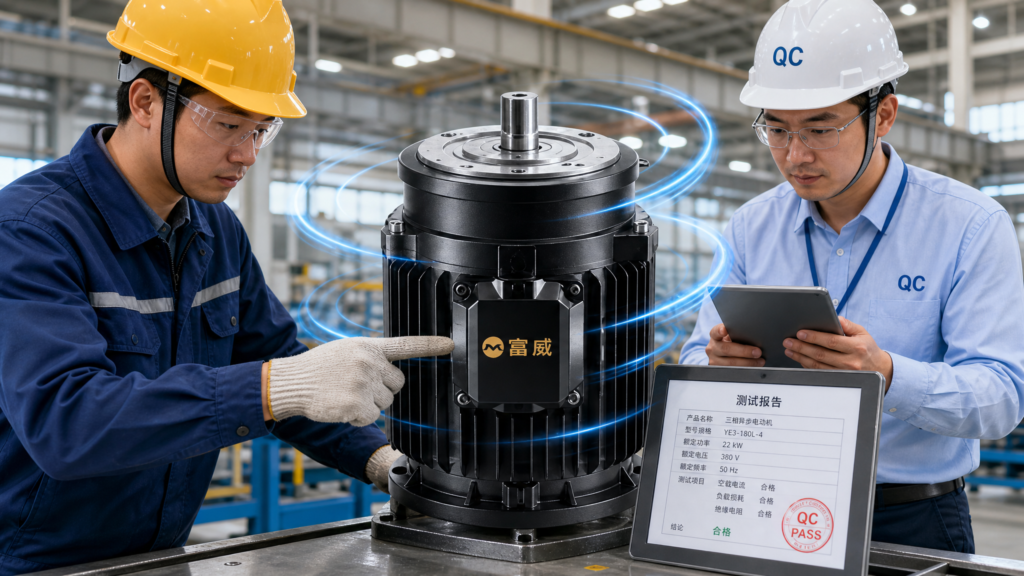
A supplier that cannot provide a test report per batch cannot prove consistency. Require **no-load current, locked-rotor current, vibration, and insulation resistance** as standard deliverables. This is the single most effective way to audit a **commercial asynchronous motor** before it reaches your dock.
### Red Flag #7: One-Size-Fits-All Lead Times for Large Commercial Projects
A factory-direct supplier should phase deliveries and hold safety stock for multi-site rollouts. A single blanket lead time often means the supplier is trading through intermediaries. For large **commercial asynchronous motor** projects, split lead times and buffer stock protect your schedule.
## Factory-Direct Quality Control: How It Prevents Equipment Matching Risk
Full-process industrial QC is not a marketing phrase. It is the difference between a motor that runs **40,000 hours** and one that fails at 4,000. Factory-direct **commercial asynchronous motor** suppliers control the process from lamination to final test, which removes the guessing from procurement.
### In-House R&D and Winding Consistency
Original factories that design, wind, and assemble in-house can adjust slot fill, insulation class, and rotor balancing to your exact load profile. Third-party traders cannot. In-house R&D also means the factory can verify torque curves against your application instead of copying a generic catalog value.
### End-of-Line Testing You Should Require
Ask for these tests as a standard deliverable, not an add-on:
– **No-load test** — current, speed, and input power at rated voltage.
– **Locked-rotor test** — starting torque and locked-rotor current.
– **Vibration test** — ISO 10816 limits at rated speed.
– **Insulation resistance** — megger test at 500V or 1,000V.
A factory that runs and records these tests catches winding, balancing, and bearing issues before shipping.
## In-Stock + Custom Dual Delivery: Matching Speed and Fit
Commercial projects rarely fit one delivery model. A **commercial asynchronous motor supplier** with both stock and custom capability de-risks fast replacements and engineered integrations.
### When Off-the-Shelf Motors Work
If the application matches a standard IEC/NEMA frame, common voltage, and standard enclosure, an in-stock **commercial asynchronous motor** ships in days and keeps your retrofit on schedule. Off-the-shelf also makes sense for spare-parts programs where consistency matters more than optimization.
### When a Custom Frame or Winding Is the Cheaper Long-Term Option
Special shaft extensions, tropicalized insulation, inverter-duty windings, or odd voltage/frequency combinations often justify a custom build. A **$300 custom modification** frequently saves **$3,000 in couplings, adapters, and field labor**. Factory-direct suppliers with in-house tooling can deliver this without the markup of a trading intermediary.
## Export Certifications and Total Cost of Ownership
The cheapest motor is rarely the cheapest project. Energy, downtime, and compliance costs dominate **total cost of ownership (TCO)** in **commercial asynchronous motor procurement**.
### Efficiency Class: IE3 vs IE4 Over 10 Years
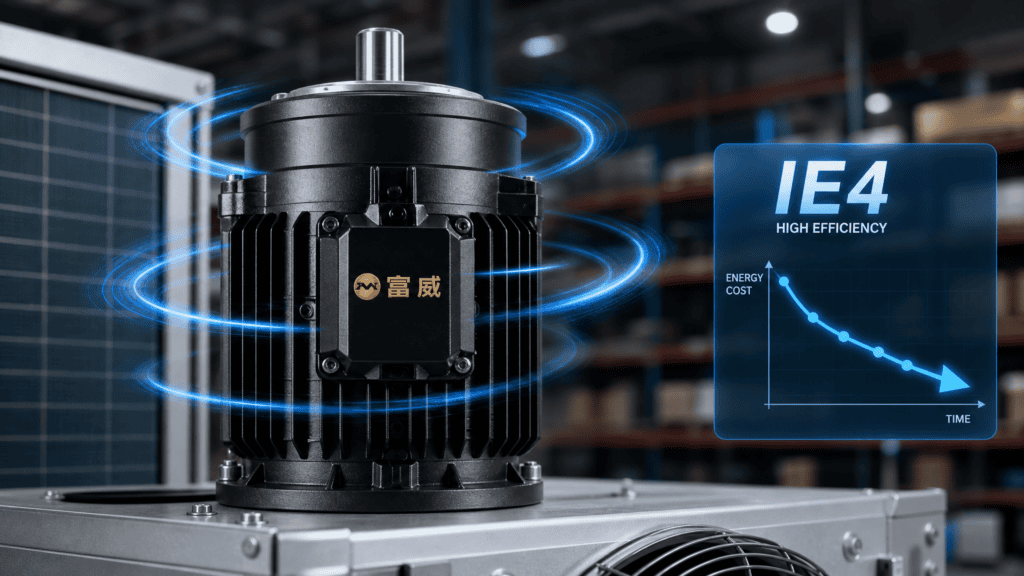
An **IE3 or IE4** motor can cut energy use by **3–8%** versus older IE1 designs. Over **40,000 operating hours**, that difference often exceeds the purchase price several times. For continuous-duty commercial loads, the efficient motor is the cheaper motor.
### Regional Compliance That Protects Export Margins
Verify **CE (EU), UL/CSA (North America), CCC (China), and EAC (Eurasian Union)** certificates before ordering. A motor without the right mark can be refused at customs, delay project handover, and trigger chargebacks. Complete export certification is a factory-level capability, not a sticker.
## Commercial Motor Procurement Checklist: 8 Checks Before You Sign
Use this checklist to audit any **commercial asynchronous motor** quote:
1. Load profile and torque curve documented, not just horsepower.
2. Duty cycle and service factor confirmed in writing.
3. Copper vs aluminum winding stated explicitly.
4. Certifications match the exact destination market and model.
5. Batch test reports included in the quote at no extra cost.
6. All-in pricing: unit + tooling + freight + packaging.
7. Lead time split for large projects with safety stock.
8. Factory traceability or audit record available on request.
### Three Key Takeaways
First, most **commercial asynchronous motor** failures are procurement errors, not manufacturing defects. Second, factory-direct QC, complete export certifications, and dual stock/custom delivery remove the largest equipment matching risks. Third, a cheap quote with hidden MOQ and tooling traps usually costs more than an honest factory-direct price.
Use this checklist to audit your current motor supplier before your next purchase order. Request batch test reports, confirm certification marks, and ask for all-in bracket pricing—then share this guide with your engineering and procurement teams.
—
## 📚 Related Resources
– **Commercial Asynchronous Motor Torque Curves Explained** → /guides/commercial-asynchronous-motor-torque-curves
– **IE3 vs IE4 Motor Efficiency & TCO Comparison** → /blog/ie3-vs-ie4-motor-efficiency-tco
– **How to Read a Motor Batch Test Report** → /resources/motor-batch-test-report-checklist
– **Factory-Direct vs Reseller Motor Pricing: The MOQ Trap** → /blog/factory-direct-motor-pricing-moq-traps
—
## ❓ Frequently Asked Questions
**Q:** What is the biggest equipment matching risk in commercial asynchronous motor procurement?
**A:** The biggest risk is selecting a motor by horsepower and frame size alone while ignoring torque curves, duty cycle, and service factor. This mismatch causes overload trips, stalls, and premature insulation failure—often adding $18,000–$25,000 in rework before commissioning.
**Q:** Should I choose copper or aluminum windings for a commercial asynchronous motor?
**A:** Copper windings are the safer default for continuous-duty commercial loads. They run cooler, deliver lower losses, and extend insulation life at the same frame size. If a datasheet does not state copper winding, confirm before ordering.
**Q:** Which export certifications should a commercial asynchronous motor have?
**A:** It depends on the destination market. Common requirements include CE for the EU, UL/CSA for North America, CCC for China, and EAC for the Eurasian Union. Always verify certificates match the exact model and frame number.
**Q:** Can one factory-direct supplier handle both small and large commercial motor orders?
**A:** Yes. A reliable factory-direct supplier typically offers transparent bracket pricing and accepts both small and large commercial project orders, with split lead times and safety stock for multi-site rollouts.
**Q:** What test reports should I request before buying a commercial asynchronous motor?
**A:** Request no-load current, locked-rotor current, vibration (ISO 10816), and insulation resistance (megger) reports as standard deliverables. Batch-level traceability records add further proof of consistency.