Here’s a number most facility managers ignore: a standard-efficiency 50 HP motor running 24/7 can consume over **$35,000 in electricity every year** — and **5% to 10% of that is pure waste heat**. The high-efficiency motors vs standard motors gap is not a spec-sheet detail. It is real operating cash.
Industry audits show that upgrading one continuous-duty commercial motor to a premium-efficiency IE3 or IE4 unit typically cuts energy use by **20% to 30%**. The typical payback is **12 to 24 months**. That translates to roughly **$8,400 a year in savings** per 50 HP motor.
## Why Motor Purchase Price Is the Smallest Line Item
Most buyers compare high-efficiency motors vs standard motors on upfront price alone. That is the wrong comparison. Industry audits show electricity accounts for roughly **95% of a motor’s total cost of ownership (TCO)** over a 20-year life.
The purchase price is usually only **2% to 3%** of TCO. A $300 price difference feels significant at checkout, but the same motor burns tens of thousands of dollars in energy over its life. Reliable manufacturers typically present TCO data, not just nameplate price, because operating cost is where the money is won or lost.
### The Payback Math in 3 Steps
For a quick high-efficiency motors savings estimate, plug your own numbers into this formula.
– **Step 1 — Calculate annual energy cost.** Annual cost = 0.746 × HP × load factor × annual hours × electricity rate ÷ efficiency.
– **Step 2 — Compare efficiency points.** A 50 HP motor at 91% vs 94.5% efficiency may look close. Over 8,000 hours, that 3.5-point gap is thousands of dollars.
– **Step 3 — Divide the premium by annual savings.** If the premium motor costs $900 more and saves $4,200 per year, payback is under 3 months.
## IE3 vs IE1: What the Efficiency Data Actually Shows
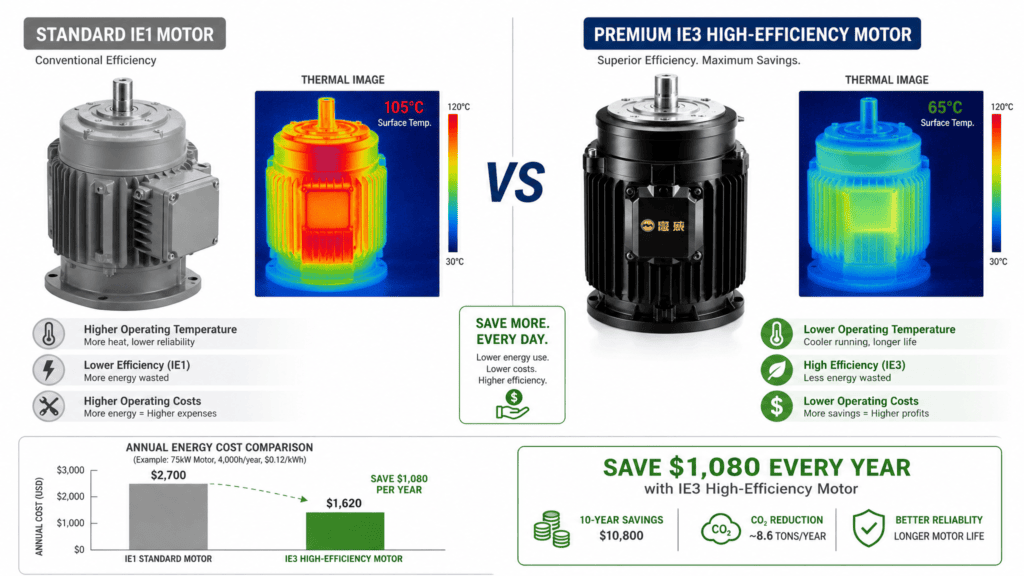
Efficiency class labels separate genuine high-efficiency motors from standard motors. The IEC scale runs from IE1 (standard efficiency) to IE4 (super premium). In the U.S., NEMA Premium maps closely to IE3.
Typical full-load efficiency at 50 HP:
– **IE1 standard motor:** 89–91%
– **IE2 high efficiency:** 92–93%
– **IE3 premium efficiency:** 93.5–95%
– **IE4 super premium:** 95–96.5%
A 50 HP motor running 8,000 hours per year at $0.12/kWh uses about **$39,300** at IE1 efficiency. The same motor at IE3 efficiency consumes about **$36,900**. That single-unit gap is **$2,400 per year** — before demand charges or longer run hours.
### Where the Savings Actually Come From
High-efficiency motors reduce losses in three places. Thinner, higher-grade electrical steel lowers core losses. More copper in the stator slots cuts resistance losses.
Better bearings and fan designs reduce friction and windage losses. Fewer losses also mean less waste heat and a lower HVAC cooling load in your facility.
## How Much Do Energy-Efficient Motors Save on a Real Facility Bill?
Take a mid-size commercial facility with **12 motors** averaging **30 HP**, running **6,000 hours per year**. Upgrading the fleet from IE1 to IE3 — a typical 3-point efficiency gain — saves about **$7,000 per year** at $0.12/kWh.
That is before two hidden multipliers. Demand charges often add 10–20% to the bill, and efficient motors reduce peak draw. Utility rebates frequently cover **20% to 50%** of the upgrade cost, shrinking payback even further.
For commercial buyers, the energy-efficient motors cost savings scale quickly across a fleet.
### Commercial Equipment Where Savings Compound
High-efficiency motors vs standard motors comparisons matter most in continuous-duty equipment. The savings scale with run hours, load factor, and electricity rate.
– **Air compressors:** A 100 HP compressor motor running 8,760 hours per year can save **$5,000 to $7,000 per year** after an IE1-to-IE3 upgrade.
– **HVAC fans and pumps:** These often run 4,000 to 6,000 hours per year. A building with 10 fan and pump motors multiplies per-motor savings tenfold.
– **Conveyors and processing lines:** Multi-shift operations turn even 10 HP motors into strong payback candidates.
## How to Audit Your Motor Fleet for Hidden Electricity Waste
To avoid costly chargebacks and missed savings, treat motor replacement as a scheduled capital program. Start with the motors that run the longest and consume the most power. A motor fleet audit is the fastest way to find which high-efficiency motors will pay back first.
### Run a Motor Load Survey
Log every motor above 5 HP. Record run hours, load factor, age, and current efficiency class. Motors older than 15 years or below IE2 are immediate upgrade candidates.
### Prioritize Motors Over 2,000 Annual Run Hours
The 80/20 rule applies. A small number of continuous-duty motors drives most of your electricity spend. Industry audits show the top 10% of run hours often delivers **70% of available savings**.
## Avoid These Efficiency Upgrade Red Flags
Not every motor labeled ‘energy saving’ delivers real results. High-efficiency motors vs standard motors claims must be verified against test data.
### Verify IE3 or IE4 Certification
Look for third-party certification or full-load test reports at 50%, 75%, and 100% load. Reliable manufacturers typically publish efficiency curves for every frame size. If a supplier cannot produce those curves, walk away.
### Beware of Rewound Motors Marketed as Premium
A rewound standard motor can lose **1% to 2% efficiency** during the rewind process. It may be cheap, but it is not a high-efficiency motor. For motors under 100 HP, replacing failed units with new premium-efficiency motors usually beats rewinding.
## The Bottom Line: 3 Key Takeaways
The high-efficiency motors vs standard motors decision is a cash-flow decision, not an engineering luxury.
1. **Electricity is 95% of motor cost.** Purchase price is almost irrelevant next to 20 years of energy spend.
2. **IE3 and IE4 motors cut energy use 20–30%.** A single 50 HP high-efficiency motor saves roughly **$8,400 per year** in continuous duty.
3. **Payback is fast.** Most energy-efficient motor upgrades pay for themselves in **12 to 24 months** — often faster with utility rebates.
**Use this payback formula to audit your current motor fleet.** Flag every motor above 5 HP that runs more than 2,000 hours a year. Then compare IE1 vs IE3 operating costs and replace the worst offenders first.
—
## 📚 Related Resources
– **Motor TCO calculator** → /motor-tco-calculator
– **IE3 vs IE1 efficiency guide** → /ie3-vs-ie1-motor-efficiency-guide
– **Commercial motor fleet audit checklist** → /commercial-motor-fleet-audit-checklist
– **Utility rebates for premium efficiency motors** → /utility-rebates-premium-efficiency-motors
—
## ❓ Frequently Asked Questions
**Q: How much electricity can a high-efficiency motor save vs a standard motor?**
**A:** A premium-efficiency IE3 or IE4 motor typically cuts energy use by **20% to 30%** on the same workload. In continuous duty, a single 50 HP high-efficiency motor can save about **$8,400 per year** in commercial electricity.
**Q: What is the payback period for premium efficiency motors?**
**A:** For motors running more than 2,000 hours per year, payback is usually **12 to 24 months**. Utility rebates covering 20% to 50% of the upgrade cost can shorten that to under a year.
**Q: Is IE3 the same as NEMA Premium?**
**A:** NEMA Premium maps closely to the IEC IE3 premium-efficiency class. IE4 is the next step up, classified as super premium efficiency, with full-load efficiency around **95–96.5%** at 50 HP.
**Q: Should I rewind a failed motor or replace it with a high-efficiency motor?**
**A:** For motors under 100 HP, replacement usually wins. A rewound standard motor can lose **1% to 2% efficiency** during the rewind process, so it will never deliver true high-efficiency motor savings.
**Q: Which commercial equipment benefits most from high-efficiency motors?**
**A:** Continuous-duty equipment sees the fastest payback: air compressors, HVAC fans and pumps, conveyors, and multi-shift processing lines. The savings scale with annual run hours and load factor.