A single overlooked tolerance in **industrial motor customization** can cost a commercial equipment OEM **$50,000** in mold changes, stalled production, and field failures. Industry audits show that nearly **60%** of non-standard motor projects exceed their original budget—mostly because of preventable supplier gaps, not engineering complexity. This guide breaks down five **industrial motor customization** traps and shows how drawing review, rapid prototyping, and mature engineering integration keep OEM budgets on track.
## The Hidden Cost of Industrial Motor Customization: Why “Cheap” Quotes Backfire
Most **industrial motor customization** failures are not caused by bad motors. They are caused by bad quoting, unclear specs, and rushed approvals. A quote that looks **15% cheaper** often hides tooling fees, revision charges, and MOQ buffers that surface after the purchase order is signed.
Reliable manufacturers typically separate one-time NRE (non-recurring engineering) costs from unit pricing. That transparency lets you compare real landed cost instead of sticker price.
### Where Hidden Charges Hide
– Tooling and fixture amortization
– Drawing revision fees after the second change
– Minimum order quantity (MOQ) penalties
– Sample freight and import duties
### The Real Price of a Non-Standard Motor
Industry audits show that a poorly managed **industrial motor customization** project can carry **20–40%** rework cost. Most of that rework traces back to skipped drawing review or missing prototype verification.
## Red Flag #1: Suppliers That Quote Without a Formal Drawing Review
A supplier that quotes from a napkin sketch or a photo of an existing motor has not priced the job. Formal drawing review is the first gate of **industrial motor customization**. It catches impossible tolerances, interference points, and missing environmental specs before money changes hands.
Mature suppliers typically return a marked-up PDF within **48 hours**, with DFM notes on shaft runout, bearing load, insulation class, and mounting footprint.
### What a Real Drawing Review Covers
– Dimensional feasibility and GD&T tolerances
– Winding, voltage, and insulation class checks
– Thermal, duty cycle, and IP rating requirements
– Shaft, keyway, flange, and connector matching
### The Tolerance Trap That Triggers Rework
Over-specifying a tolerance “just to be safe” often doubles machining cost and forces rejections. Reliable manufacturers typically push back with a tolerance stack-up analysis instead of quietly accepting the spec and billing you later for scrap.
## Red Flag #2: No Rapid Prototyping or Sample Verification Before Mass Production
Skipping rapid prototyping is the fastest way to turn a **$3,000** sample into a **$30,000** rework. In **industrial motor customization**, a verified sample validates mounting, thermal behavior, noise, and control compatibility before tooling is locked.
Fast sample turnaround matters commercially, too. OEMs that wait **10–12 weeks** for a prototype miss product launch windows. Strong suppliers typically deliver functional non-standard motor samples in **2–4 weeks**.
### Why a $3,000 Sample Saves $30,000
A prototype catches the mismatches that drawings cannot show—connector orientation, cable exit direction, vibration under load, and fit inside the machine cavity. Fixing these after mold building is **10x more expensive**.
### Prototype Approval Checklist
– Run at full load for 30 minutes
– Measure temperature rise, current draw, and RPM
– Verify shaft runout and noise under load
– Confirm connector, lead length, and mounting pattern
## Red Flag #3: Weak Engineering Integration and Vague Non-Standard Specs
**Industrial motor customization** fails when the supplier’s salesperson cannot talk to your mechanical and electrical engineers. Weak engineering integration shows up as unanswered questions, generic drawings, and “we can do it” promises without supporting calculations.
Mature engineering integration means the supplier assigns a dedicated applications engineer who reviews your system requirements, not just the motor drawing. That person should ask about startup torque, ambient temperature, altitude, and duty cycle before quoting.
### Questions to Test Engineering Depth
Ask these before you commit to any **industrial motor customization** project:
– “What is the locked-rotor current at my voltage tolerance?”
– “How does the insulation class change at 45°C ambient?”
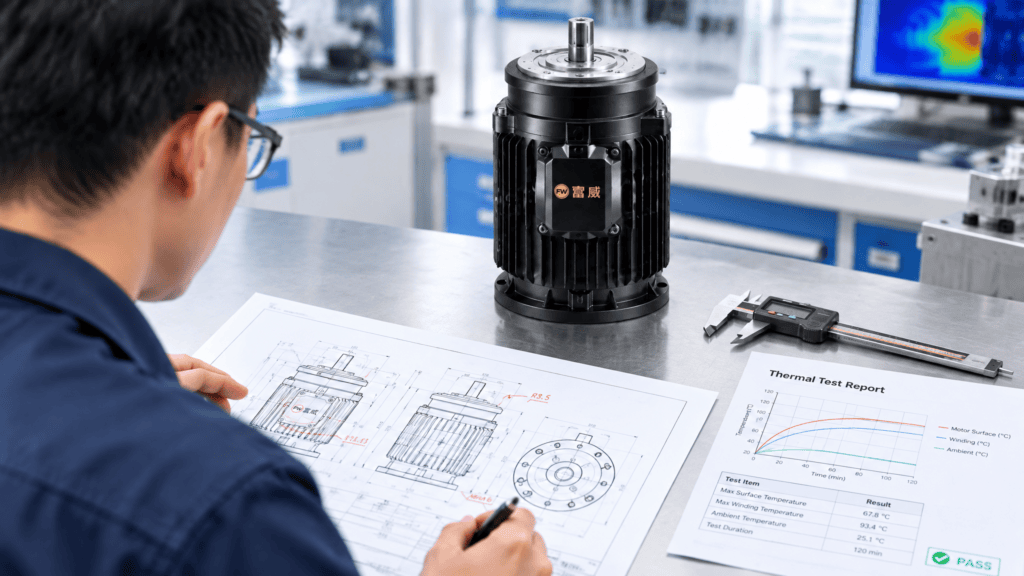
– “Can you share a thermal simulation or test report from a similar frame size?”
### How Mature Suppliers Lock the Spec Early
Reliable manufacturers typically freeze the specification after the first article inspection. They issue a golden sample and a signed approval sheet. This is the most underrated step in **industrial motor customization**—it prevents the silent spec drift that causes field failures and chargebacks.
## Red Flag #4: Opaque MOQ, Tooling Fees, and Revision Charges
The most expensive line item in **industrial motor customization** is rarely the motor. It is the tooling fee, MOQ penalty, or revision charge buried in the fine print. Suppliers that cannot itemize these costs are transferring risk to you.
Industry audits show that hidden revision fees add **8–15%** to the total project cost when drawings change more than twice. A clear quote lists exactly how many revisions are included and what each additional change costs.
### Decode the Quote
Ask the supplier to separate:
– Unit motor price vs. one-time NRE/tooling
– Included drawing revisions vs. chargeable changes
– MOQ and price-break structure
– Sample cost and freight terms
### Contract Clauses That Protect You
– Lock tooling ownership and transfer rights
– Cap revision fees after the golden sample
– Define acceptance criteria and rework liability
– Require notification before any material or process substitution
## Red Flag #5: No Track Record in Commercial Equipment Applications
A motor that works in a lab may fail on a commercial compressor, pump, conveyor, or packaging line. **Industrial motor customization** requires application-specific knowledge of starting duty, thermal cycling, ingress protection, and vibration. Application proof is the strongest predictor of long-term success in non-standard motor programs.
Reliable manufacturers typically provide case studies from similar OEM segments, such as food processing, HVAC, material handling, or medical equipment. They can name the frame sizes, duty cycles, and failure modes they have solved.
### Proof Points to Request
– Reference customers in your equipment category
– Test reports for similar custom motors
– ISO 9001 or IATF 16949 quality system certifications
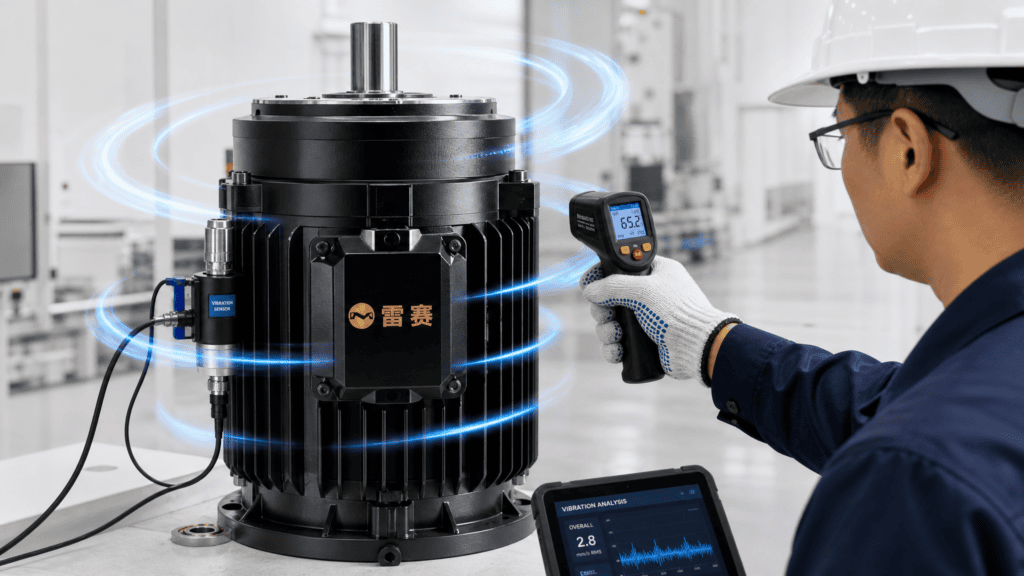
– In-house testing capability for temperature, vibration, and IP rating
### Supplier Audit Checklist
– Inspect the winding and assembly lines
– Review the incoming material inspection records
– Ask how they trace non-conforming parts
– Confirm their rework and corrective action process
## How to Audit a Custom Motor Supplier Before You Commit
Use this procedural checklist to compare suppliers side by side. To avoid costly chargebacks, run every **industrial motor customization** partner through the same five gates before issuing a purchase order.
1. **Drawing review:** Did you receive marked-up DFM feedback within 48 hours?
2. **Rapid prototyping:** Can they ship a functional sample in 2–4 weeks?
3. **Engineering integration:** Do they assign an applications engineer to your account?
4. **Transparent quoting:** Are NRE, tooling, MOQ, and revision fees itemized?
5. **Application proof:** Can they show test data from your equipment category?
A “yes” to all five gates is the baseline for a reliable **industrial motor customization** partner. Anything less predicts rework, chargebacks, and delayed production runs.
## Conclusion: 3 Takeaways to Protect Your Custom Motor Budget
**Industrial motor customization** does not have to be a gamble. The difference between a **$50K** rework and a smooth launch usually comes down to supplier process, not motor price.
Three key takeaways:
1. **Never quote without a formal drawing review**—it catches tolerance and interference issues before tooling starts.
2. **Demand rapid prototyping and a golden sample**—a $3,000 sample routinely prevents $30,000 in mold rework.
3. **Verify engineering depth and application proof**—weak integration and generic experience are the top predictors of hidden cost.
Use this five-gate checklist to audit your current or next **industrial motor customization** supplier before you sign. One hour of screening now can protect your entire production budget.
—
## 📚 Related Resources
– Anchor text: “custom motor drawing review checklist” → /custom-motor-drawing-review-checklist
– Anchor text: “rapid prototyping for OEM motors” → /rapid-prototyping-oem-motors
– Anchor text: “industrial motor supplier audit checklist” → /industrial-motor-supplier-audit-checklist
– Anchor text: “non-standard motor cost guide” → /non-standard-motor-cost-guide
—
## ❓ Frequently Asked Questions
**Q:** What is the biggest hidden cost in industrial motor customization?
**A:** The biggest hidden cost is usually one-time NRE and tooling fees, plus revision charges that kick in after the second drawing change. These can add 8–15% to a project when they are not itemized upfront.
**Q:** How fast should a custom industrial motor prototype be delivered?
**A:** Strong suppliers typically deliver functional non-standard motor samples in 2–4 weeks. If a supplier quotes 10–12 weeks, ask whether they have in-house rapid prototyping or are outsourcing the sample.
**Q:** Why is a formal drawing review necessary before quoting?
**A:** A drawing review catches impossible tolerances, interference points, and missing environmental specs before tooling starts. It is the cheapest point to fix a motor design—after mold building, changes cost 10x more.
**Q:** What MOQ should I expect for custom industrial motors?
**A:** MOQs vary by frame size and tooling, often ranging from 10 to 100 units. Always ask for itemized MOQ penalties and price-break structure so you can compare true landed cost.
**Q:** How do I verify a supplier’s engineering integration?
**A:** Ask specific technical questions about locked-rotor current, insulation class at high ambient temperature, and thermal test data. A mature supplier assigns a dedicated applications engineer who answers with calculations, not generic promises.